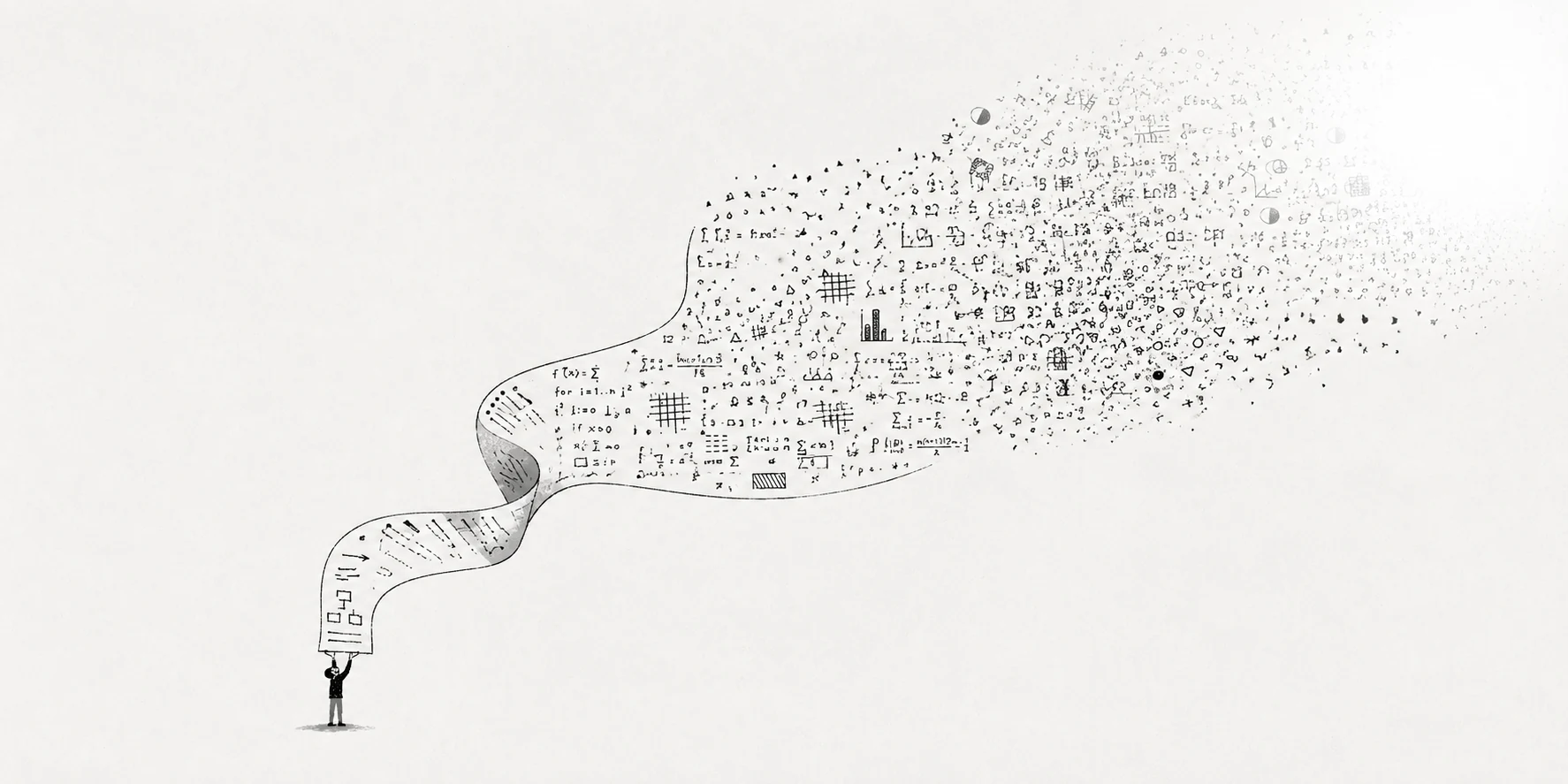
At around three in the morning, as one does, I was talking to ChatGPT. The chat drifted from religion to the future of AI, and then to the possibility that AI might one day produce knowledge humans could test and use without being able to understand it.
This is not an entirely new concern. Researchers have been discussing interpretability, superhuman reasoning and the difficulty of verifying advanced systems for years. I had just never thought much about what it might feel like to live on the other side of that gap.
My dog can watch me use a phone. He knows that I stare at it, touch it, speak towards it and sometimes take off my headphones before taking him outside. He can learn these patterns without coming any closer to understanding software, radio transmission or language models.
At the vet, the same gap matters more. He may learn that the building means pain, strange smells and occasionally feeling better afterwards. He cannot understand microbiology, diagnostic uncertainty or why I have agreed to let a stranger insert a needle into him. There is no clearer wording I could use to make the missing framework appear.
What remains available to him is reliability. Headphones coming off may predict a walk. A frightening visit may be followed by relief. He cannot reconstruct the process, but he can form expectations about its effects.
Now imagine that an advanced AI develops a theory humans cannot understand for similar reasons. Not because it refuses to explain, or because the mathematics is merely difficult, but because the theory depends on concepts or relationships our minds cannot represent faithfully.
We might still be able to test it. It predicts that lightning will strike a particular tree at 14:37 the next day. It does. Materials designed using the theory behave as expected. A treatment based on it works. Other systems reproduce the results.
That would establish reliability, not understanding. The theory could still be wrong outside the conditions in which it had been tested, but continued success would make it difficult to dismiss simply because no human could follow it.
The gap would probably develop gradually. At first, AI might produce theories that researchers can understand. Later, it might provide simplified explanations that are useful but incomplete. Eventually, those explanations could become more like interfaces: enough information to test a result, build something or make a decision, without access to the framework connecting it all.
We often imagine incomprehensible knowledge as harder mathematics or longer proofs. The real barrier might be closer to the one between my dog and the phone. The problem would not be vocabulary. It would be the absence of the concepts needed to build the relevant model at all.
Human knowledge has never been only practical. We teach it, argue about it and use it to decide who should be trusted. Even highly specialised work can, in principle, be passed between people and brought into human culture.
Knowledge that could be used but never understood would sit differently. A treatment that reliably cures an illness might be easy to accept. Advice about how to organise a society would not. The same system could be treated as a tool in one context and something closer to an oracle in another.
This was where the conversation wandered back towards religion.
Religions have spent a long time trying to give shape to things too large or strange to fit inside ordinary human experience: creation, eternity, beings outside the visible world, or rules of reality that might look different from another perspective. These ideas are usually rendered through stories, images and human relationships because those are the forms available to us.
An AI working beyond those forms might return with something narrower: predictions, approximations or instructions that humans could use without fully understanding what they referred to. From our side, the relationship might begin to resemble revelation—not because the machine had become divine, but because we would be receiving claims we could test without being able to reconstruct them.
Somewhere around this point, I wrote:
“There is no avenue of communication between you and God.”
It seemed like a good title.
The “God” in the conversation was not necessarily a being. It was a rough label for whatever parts of reality might remain inaccessible to human thought even if another kind of intelligence could work with them. AI would not create that distance. It might simply make it harder to ignore.
Whether anything like this happens is another matter. For now, the possibility is mostly useful as a reminder that human comprehension and reality are not guaranteed to have matching edges.
In the meantime, I’ll try to appreciate living through what may turn out to be one of the last stretches of history I can still understand for myself.